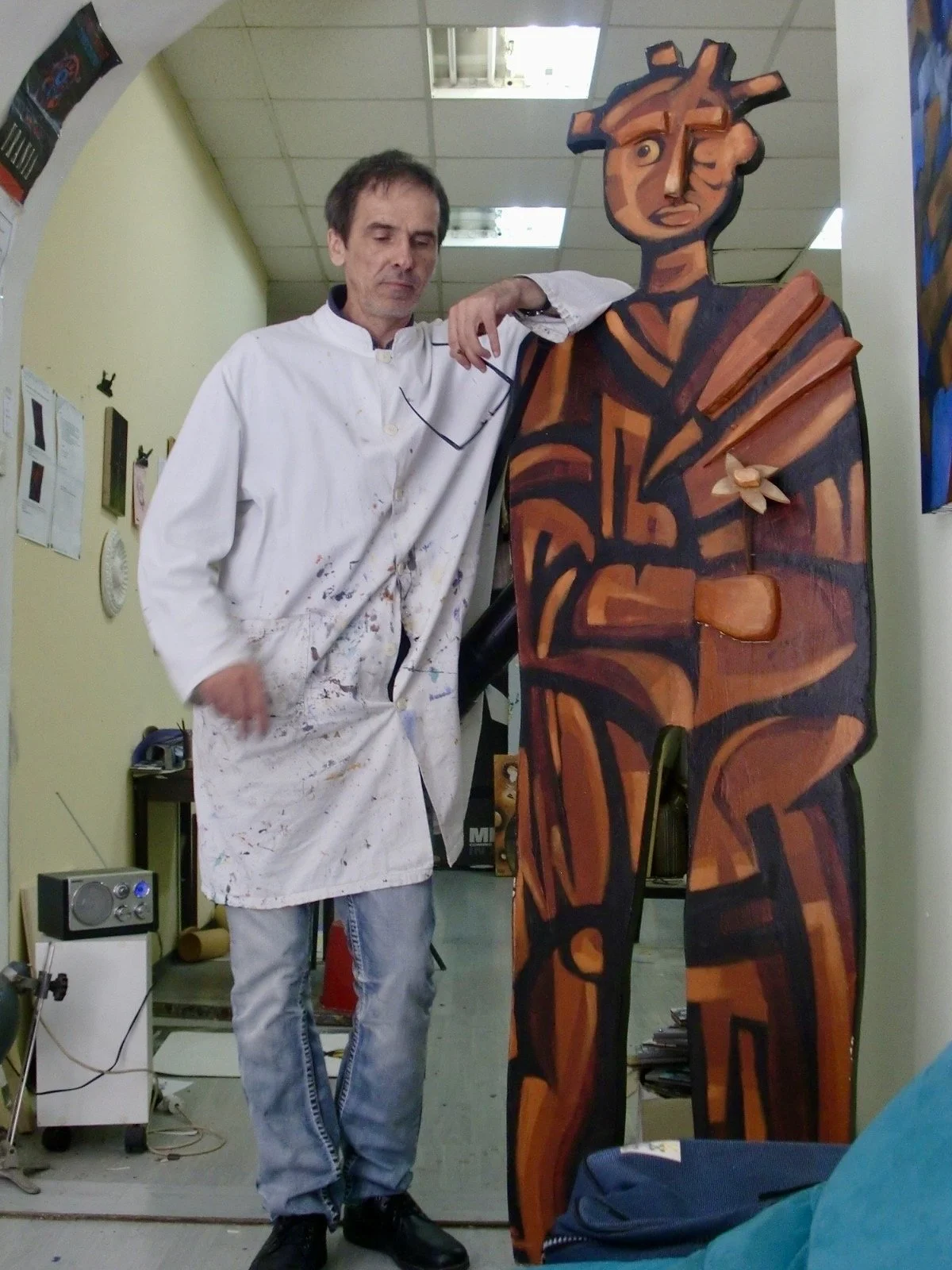
Klas Grdić (b. 1963, Rijeka) is a Croatian painter and multimedia artist, one of the recognized figures of the European art scene since the mid-1980s.
Training and status — He graduated in 1988 from Rijeka's Pedagogical Faculty in fine arts, sculpture department, under Josip Diminić, and has exhibited solo since 1986, with around twenty solo shows and over a hundred group exhibitions. He's a member of HDLU Rijeka and works as an independent artist — registered with HZSU (the Croatian Freelance Artists' Association) as a painter.
His practice is characterized as unconventional and experimental, merging painting with sculpture, installation and spatial intervention, so that two-dimensional works acquire an added spatial dimension. Wood, acrylic and pastel are his core materials, used for surreal scenes and portraits; he's a colorist at heart, playing warm against cool. The trajectory runs from early grotesque, emotionally charged portrait heads, through fantastical landscapes and 1990s oil-on-glass works, to recent pieces that strip out detail in favor of gesture and free application of paint.
Biography
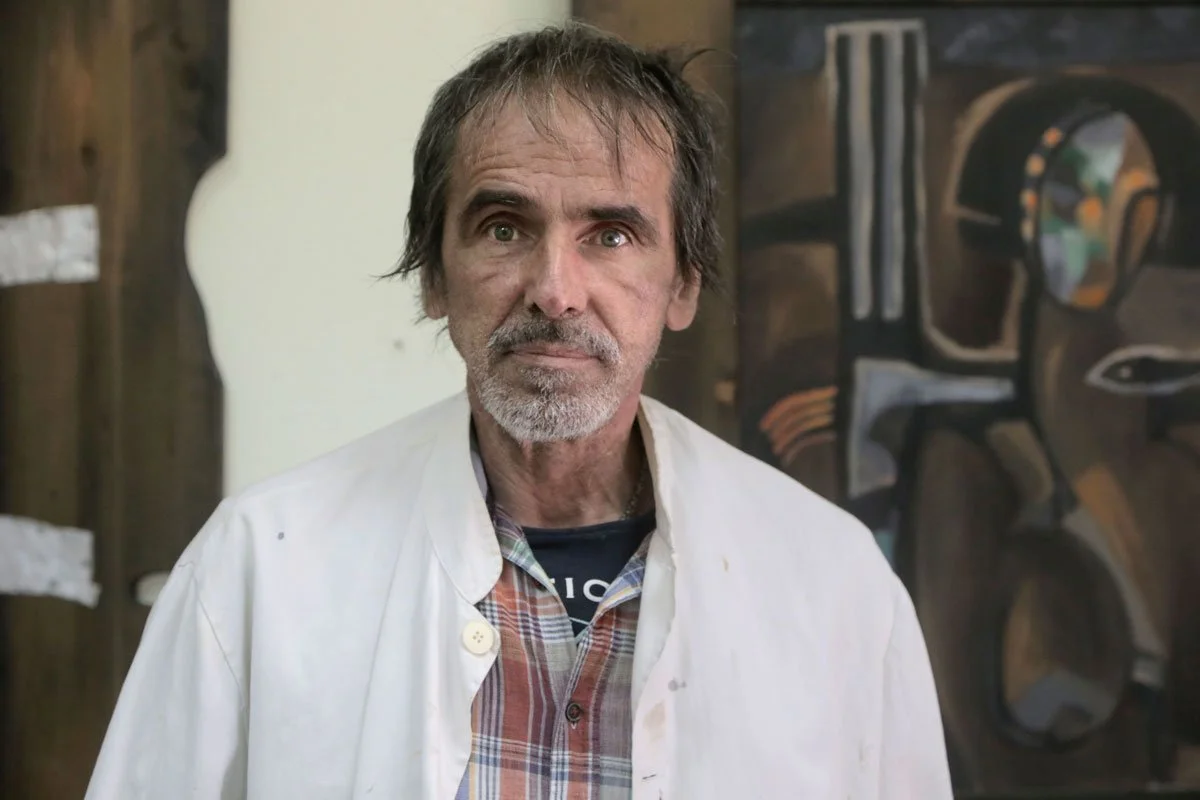
KLAS GRDIc
Painter, sculptor, and multimedia artist Born 1963, Rijeka, Croatia. Lives and works in Rijeka. Studio: Dežmanova ulica, Rijeka
EDUCATION
1988 — Diploma, Faculty of Education (Pedagoški fakultet), University of Rijeka Department of Fine Arts (likovna kultura), Sculpture, in the class of Prof. Josip Diminić. Additional studies with Prof. Butković and Prof. Radmila Matejčić.
PROFESSIONAL STATUS
Independent artist (samostalni umjetnik), Croatian Freelance Artists' Association (HZSU), registered as painter
Member, Croatian Association of Fine Artists — Rijeka (HDLU Rijeka)
PRACTICE
Grdić works across painting, sculpture, installation, and spatial intervention, treating the two-dimensional surface as an object with depth. Primary materials are softwood, acrylic, and pastel; the artist-built wooden frame is integral to the work rather than a support for it. Earlier phases include aluminium-and-wood constructions — described by critic Ljiljana Domić as pikto-plastika — cardboard works, and a body of oil-on-glass paintings made in the 1990s.
The subject matter runs from grotesque, emotionally charged portrait heads through fantastical landscapes to recent work that reduces detail in favour of gesture and open handling of colour. Invented language and phonetic wordplay recur as inscribed elements across the surfaces. He is at core a colourist, working the tension between warm and cool registers.
SELECTED SOLO EXHIBITIONS
2026 — Lica kaosa (Faces of Chaos), retrospective, Galerija Kortil, Rijeka. 40 works, 1980s–present. Curators: Ema Makarun and Kristina Pavec. 17 April – 12 May 2026. 2011 — Mali salon, Museum of Modern and Contemporary Art (MMSU), Rijeka 1992 — Osijek 1987 — Moderna galerija, Rijeka First solo exhibition: 1986. Approximately twenty solo exhibitions to date.
SELECTED GROUP EXHIBITIONS AND BIENNIALS
2020 — With the Collection, David Maljković, MMSU Rijeka / Rijeka 2020 European Capital of Culture (invited collaborator) 2020 — International group exhibition, Kranj, Slovenia (artists from 19 countries) c. 2020 — Group exhibition, Franjo Tuđman Airport, Zagreb c. 2023 — International painted-aircraft project, Portugal, organised by Toni Politeo 1989 — Geofigurazione, Trieste, Italy, with Zlatko Vrkljan and Dušan Jurić 1985 — Group 5R (Pet R), Governor's Palace / Maritime and History Museum of the Croatian Littoral (PPMHP), Rijeka
Regular participation in the principal Croatian survey exhibitions and biennials, including the Biennial of Young Artists (Rijeka), the Youth Salon (Zagreb), the International Exhibition of Drawing, New Croatian Art, and the FONA international exhibition. Over one hundred group exhibitions in Croatia and abroad.
PERFORMANCE, THEATRE, AND COLLABORATIVE PROJECTS
1990 — Co-founder, Poet teatar, with poet Igor Večerina and musician Siniša Vukotić. The organisation staged poetske mise ("poetic masses") — music, text, and scenography combined as performance. Performances included appearances at ZKM and Gavella Theatre, Zagreb. 1993 — Urania, Poet teatar. Scenography, in collaboration with the band Let 3. Scenography for Katarina Zrinska, monodrama by Meri Lukanić, Meštrović Pavilion, Zagreb.
EDITORIAL AND ILLUSTRATION
2001– — Graphic editor, Književna Rijeka literary journal (from issue 1/2001) 2018 — Illustrations, Srh by Igor Večerina (Poet teatar), with Tomislav Ćurković
AWARDS
Award of the Print Room of the Croatian Academy of Sciences and Arts (Kabinet grafike HAZU). Recipient of further prizes and recognitions across a four-decade career.
COLLECTIONS
Works held in public and private collections in Croatia and abroad.
institutional collection
Baseline metrics establish a reference point for subsequent measurement.
private collection
Advanced analytics uncover patterns that traditional reviews may overlook.